Maison Velours · Skincare
Best Sunscreen for Indian Skin: How to Read SPF and PA Ratings
SPF is only half the label. A house guide to what SPF and PA actually protect against, how much to apply, and why sunscreen is the one step Indian skin cannot skip.
By Sadhana Ojha · Founder, The Maison World · 6 min read · Updated September 2026
For daily wear in India, the answer is a broad-spectrum SPF 50 PA++++ sunscreen you will actually reapply. Medium and deep skin tones rarely burn but tan and pigment readily, so UVA protection — the PA rating — matters as much as the SPF number, and no brightening active can outrun daily, unprotected sun exposure.
Yet the label most people buy on — the SPF number — describes only half of what matters. This is a house guide from Maison Velours to reading a sunscreen properly: what SPF and PA each protect against, how much to actually apply, and how to choose one you will genuinely wear every day.
What SPF do you actually need in India?
For daily use in India, a broad-spectrum SPF 50 is the sensible standard. SPF measures protection against UVB — the rays that burn and directly damage skin — and while SPF 30 blocks about 97% of UVB in a lab, real-world application is almost always thinner than the test, so the higher headroom of SPF 50 is what brings everyday protection closer to the number on the bottle.
The catch is that SPF beyond 50 offers only marginal extra UVB filtering, so chasing SPF 70 or 100 is largely marketing. What changes outcomes is not a bigger SPF number but broad-spectrum cover, enough quantity, and reapplication — the three things most people get wrong.
What does the PA rating mean, and why does it matter more than you think?
PA measures protection against UVA — the rays that drive tanning, pigmentation, and long-term skin ageing — and for Indian skin it often matters more than SPF. UVA penetrates deeper than UVB, passes through glass and cloud, and is present at fairly constant strength all day, which is precisely why it, not sunburn, is the main culprit behind the dark patches and dullness Indian skincare is usually trying to fix.
The PA scale runs from PA+ to PA++++, with more plus signs meaning stronger UVA defence. A sunscreen marked SPF 50 PA++++ is giving you high protection on both fronts — the combination to look for — whereas a high SPF with weak or unlisted UVA protection leaves the exact wavelength responsible for pigmentation largely unaddressed.
Does melanin-rich skin still need sunscreen every day?
Yes — and arguably needs it more consistently, not less. Higher melanin gives darker skin a modest built-in filter, estimated at roughly SPF 13 at most, which is nowhere near enough for India’s UV and does nothing to prevent the hyperpigmentation that melanin-rich skin is especially prone to after any inflammation.
Because even tone is the primary concern for most Indian skin, disciplined daily sun protection does more for clarity than any serum in the routine — including a vitamin C serum for pigmentation, which needs sunscreen behind it to work. That holds on overcast monsoon days too: UVA — the pigmentation wavelength — is barely reduced by cloud cover. Sunscreen always goes on last; see the correct layering order.
How much sunscreen should you apply, and how often?
Most people apply a quarter of what the rating assumes, which quietly turns an SPF 50 into something far weaker. The guide for the face is roughly two finger-lengths of product, or about a rupee-coin-sized amount — enough that it goes on as a visible layer, not a thin sheer smear rubbed to nothing.
Reapplication is the step that decides real-world protection. Sunscreen degrades with time, sweat, and touching, so a single morning layer is not a full day of cover — reapply every two to three hours of daylight exposure, and sooner after heavy sweating. This is where a format you can top up without disturbing makeup earns its place.
How do you choose a sunscreen you will actually wear daily?
The best sunscreen is the one you will reapply, so texture and finish matter as much as the rating. In humid Indian conditions, lightweight, non-greasy formats win — a heavy cream that leaves a white cast or a sticky film is the sunscreen that gets skipped by lunch, and a skipped reapplication is where most sun damage actually happens.
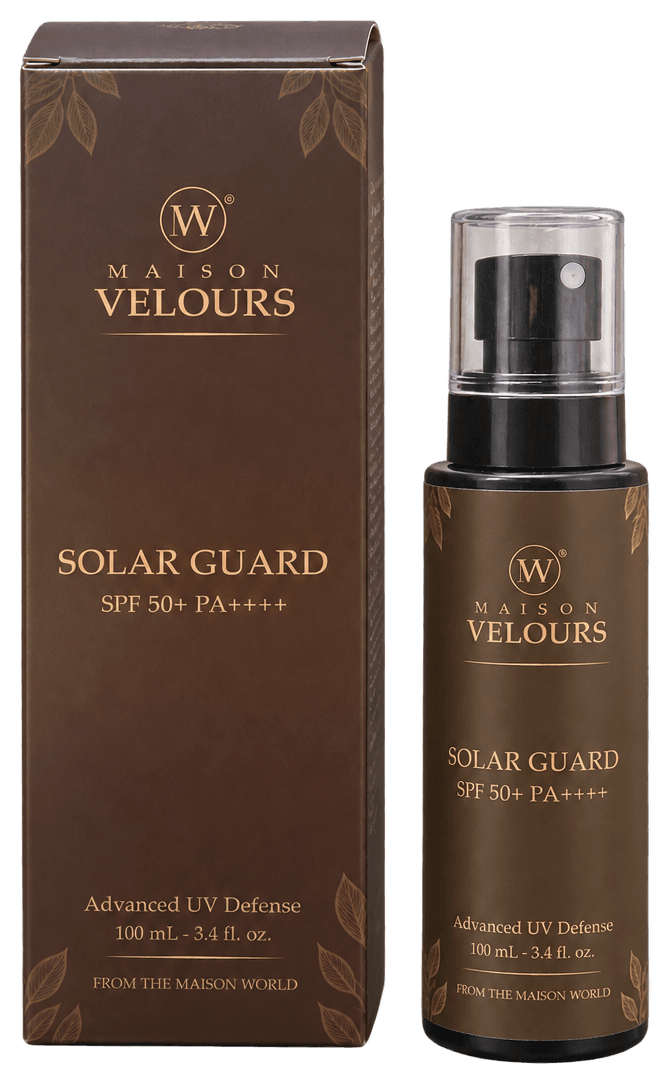
Maison Velours formulates Solar Guard as a broad-spectrum SPF 50 PA++++ spray for exactly this brief: high protection on both UVB and UVA in a format built to be reapplied through an Indian day, over skincare or makeup, without a greasy reset. Every product carries mandatory Indian statutory information, including manufacturer details, MRP inclusive of GST, and batch and expiry where applicable.
Frequently asked
- What is the best sunscreen for Indian skin?
- The best sunscreen for Indian skin is a broad-spectrum SPF 50 with a high PA rating (ideally PA++++), in a lightweight, non-greasy texture you will reapply through the day. High UVA (PA) protection matters as much as SPF because UVA drives the tanning and pigmentation most Indian skin is trying to prevent.
- What does SPF 50 PA++++ mean?
- SPF 50 measures high protection against UVB, the rays that cause sunburn and direct damage. PA++++ is the highest rating for UVA protection, the rays that cause tanning, pigmentation, and ageing. Together they mean strong, balanced protection against both — the combination to look for in India.
- How much sunscreen should I apply to my face?
- About two finger-lengths of product, or a rupee-coin-sized amount, applied as a visible layer rather than a thin smear. Reapply every two to three hours of daylight exposure, and sooner after heavy sweating, since a single morning layer does not protect for a full day.
- Do I need to reapply sunscreen if I stay indoors?
- If you sit near windows or step out at all, yes — UVA passes through glass and is present all day. If you are fully away from daylight, reapplication matters less, but most daily routines involve enough incidental sun that a morning-only application under-protects.